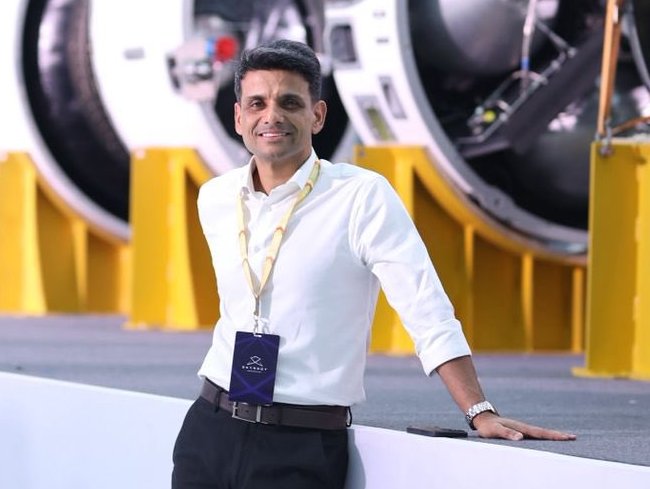
As India moves towards human spaceflight with its Gaganyaan mission, following the landmark Chandrayaan 3 mission and its successful moon landing, the poster boy for space science in the country is Indian Air Force Group Captain Shubhanshu Shukla, the first Indian astronaut to go to the International Space Station.
“To realise our ambition of a Viksit Bharat by 2047, it is necessary that we celebrate science and create an excitement among children,” said the astronaut — nicknamed “Shux” — speaking to the media on December 6 at the four-day India International Science Festival in Panchkula, Haryana.
A few days earlier, on November 27, speaking at space startup Skyroot’s facility inauguration in Hyderabad, Telangana, the astronaut said, “I think that the next five to 10 years are going to be really defining times for our country as far as space exploration is concerned. A lot of things are going to happen. And I think it is going to be bright, shiny for the kids who are coming up to explore this (space) and go forward in this domain.”
Group Capt. Shukla was part of the Axiom-4 private space mission that lifted off from Florida on June 25 and docked at the ISS on June 26. He returned to Earth on July 15.
His videos of various activities on ISS generated huge interest, and he returned to a hero’s welcome.
On November 14, Children’s Day, Shux shared a fun video of his time on ISS, with an astronaut somersaulting in zero gravity. The post accompanying the video said: “On the occasion of Children’s Day, here’s a little video of us astronauts letting our inner bachchas loose aboard the space station.”
In the post, Shukla referred to his own 6-year-old son and said that he was “constantly amazed at how effortlessly children can turn even the most mundane thing into an adventure — a cardboard box becomes a spaceship, a spoon becomes a sword”. He urged all kids: “Keep that spark of wonder glowing…”
Voicing similar sentiments today at the science festival, while interacting with students and science enthusiasts, Shukla urged them to pursue science and space research with determination.
He said that India was rapidly advancing in the field of science and technology and its self-reliance was a matter of pride for every citizen. The responsibility of maintaining this progress, he said, rested on the young.
He then told the media, “This is a good platform that celebrates science. To realise our ambition of a Viksit Bharat by 2047, it is necessary that we celebrate science and create an excitement among children. I think children now have opportunities before them. As a country, we have made it possible for them to think of becoming an astronaut as a career choice.”
Shukla said that when he returned from the mission, Prime Minister Narendra Modi spoke to him. “[PM Modi] said that there should be a pool of 40-50 astronauts and a thriving ecosystem for human space mission. Work is going on in this direction, and I feel we will reach there. Obviously, it is a challenging task that will take time to accomplish,” he told the media.
During his time on ISS, the Indian astronaut gathered a lot of data that would be vital for assessing the impact of space travel on the human body. Shukla is also one among four astronauts selected and trained for India’s first manned mission, slated for launch in 2027.
In the meantime, the Government of India informed Parliament on December 5 that the first uncrewed flight of the Gaganyaan mission would happen before March 2026. A number of uncrewed flights — at least three — are planned before India sends astronauts to space.
With the Indian space programme expanding and accelerating, Shukla emphasised that success only came through perseverance, and one should always continue to strive for it.
At the science festival interaction, a student asked Shukla if one could become an astronaut only after joining the Indian Air Force. He responded that a new framework was being developed, for opening the doors to an astronaut’s career to individuals from various fields.
Stating that India’s first astronaut Wing Commander Rakesh Sharma was his inspiration and courage, Shukla expressed confidence that many more Indians would journey into space in future.
Sharma was a pioneer who travelled to space in April 1984 with a Soviet team, and spent seven days on the Salyut 7 Soviet space station.
—With inputs from Press Trust of India