
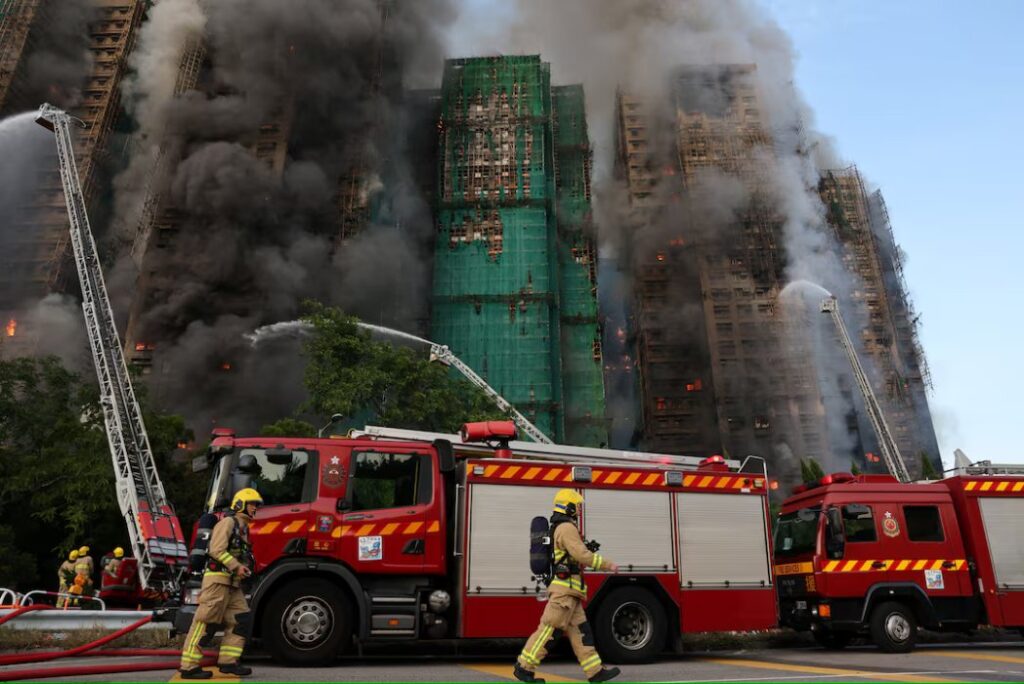
Donations for victims of the devastating Hong Kong highrise fire that killed at least 146 people and left thousands homeless have reached 900 million Hong Kong dollars (USD 115 million), authorities said on Monday, in a massive outpouring of sympathy and support.
But as questions grew over whom to blame for the deadly blaze, the government appeared to be moving swiftly to stifle criticism, said an Associated Press report via Press Trust of India.
Hong Kong was handed over from the United Kingdom of Great Britain and Northern Ireland to the People’s Republic of China on 1 July, 1997. The relationship between Mainland China and the former British protectorate has seen some serious friction. There were furious public protests in 2019-2020 in Hong Kong over an extradition bill that was seen as an attempt to undermine Hong Kong’s autonomy.
And now, following the highrise fire that gutted several buildings, online criticism of the leadership has surfaced, and as before, China has responded with a crackdown even as people are trying to help each other.
A steady stream of people placed flowers, cards and other tributes at a makeshift memorial near the burned-out block of buildings, after long lines of mourners during the weekend.
“When something happens, we come out to help each other,” said Loretta Loh, after paying her regards at the site. “I have a heavy heart.”
The fire broke out on Wednesday afternoon at the Wang Fuk Court complex in the suburb of Tai Po. It burned through seven of eight apartment towers, home to some 4,600 people, and was not fully extinguished until Friday morning.
Hong Kong Police Disaster Victim Identification Unit staff went through four of the buildings over the weekend, finding another 30 bodies that took the official death toll to 146. Another 100 people are still unaccounted for, and 79 were injured.
On Monday, the Hong Kong authorities said that teams were assessing the safety of the other buildings, including the one that caught fire first and suffered the worst damage.
The millions of donated funds, and 300 million Hong Kong dollars (USD 38.5 million) in start-up capital from the government, would be used to help victims rebuild their homes and provide long-term support, local officials said.
The government has also given survivors cash subsidies to help with expenses, including funerals, and is working to find them housing.
By Monday, 683 residents had found places in local hotels and hostels, and another 1,144 moved into transitional housing units. Two emergency shelters remained open for others, authorities said.
Affected residents had complained about flammable materials
The complex’s buildings were all clad in bamboo scaffolding draped with nylon netting for external renovations. Windows were covered with polystyrene panels, and authorities are investigating whether fire codes had been violated.
Residents had complained for almost a year about the netting that covered the scaffolding, said Hong Kong’s Labour Department. It confirmed that officials had carried out 16 inspections of the renovation project since July 2024 and had warned contractors multiple times in writing that they had to meet fire safety requirements. The latest inspection was just a week before the fire.
Hong Kong’s anti-corruption agency has arrested 11 people, including the directors and an engineering consultant of a construction company. A growing number of people have been questioning whether government officials should also be held responsible.
“People are angry and think that the HK (Hong Kong) government should be accountable,” said Jean-Pierre Cabestan, a locally-based political scientist and senior research fellow at the Paris-based Asia Centre think tank.
But the leeway for dissent is limited in the former British colony, which increasingly has moved to quiet public criticism on national security grounds.
On Saturday, the Office for Safeguarding National Security hit out with a harshly-worded statement about what it called “evil schemes” that had “the ulterior motives of using the disaster to create trouble and disrupt Hong Kong”. It did not give specifics.
On Saturday, a man who helped organise an online petition calling for government accountability was arrested on suspicion of sedition, local media, including HK01 and Sing Tao Daily, reported.
Two others were arrested on Sunday, including a volunteer who offered help in Tai Po after the fire broke out, the same outlets reported.
Cabestan said that Hong Kong authorities were operating like authorities in Mainland China, forestalling protests before they might develop.
Hong Kong Police would not comment specifically on the arrests, telling The Associated Press only that “police will take actions according to actual circumstances and in accordance with the law”.
The authorities have effectively quashed dissent in Hong Kong since hundreds of thousands took to the streets in 2019-2020 against government plans to allow extradition to Mainland China, and have virtually banned mass protests as well as opposition political figures from running in legislative elections.
—With inputs by CtoI News Desk