
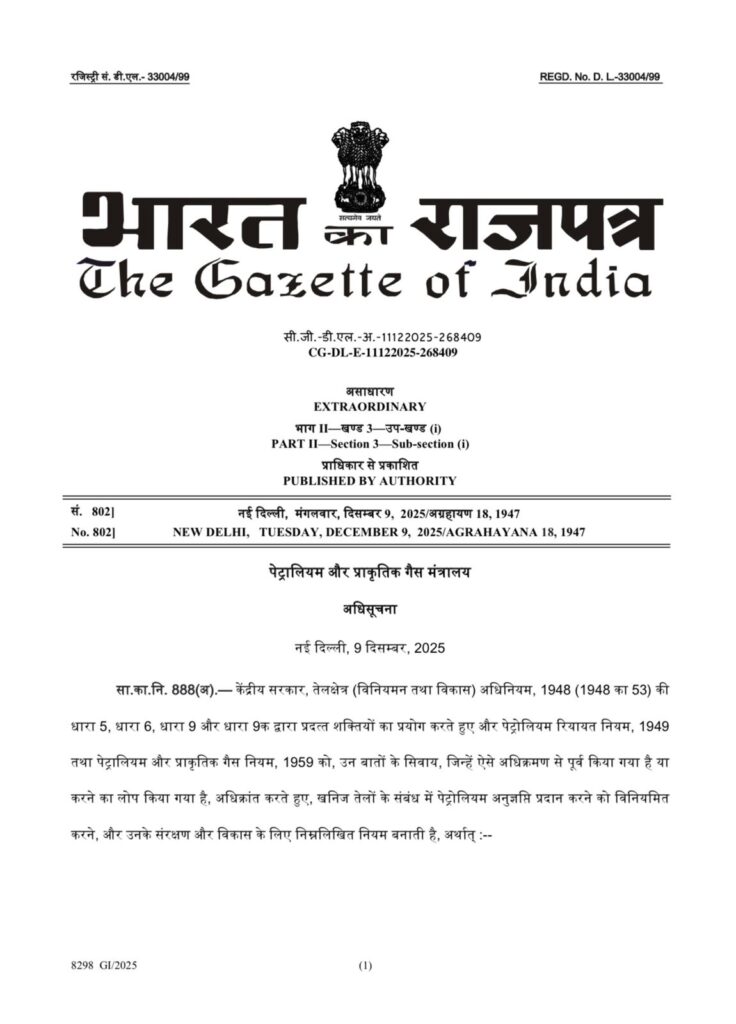
In a landmark move on Tuesday, December 9, India’s Petroleum and Natural Gas Rules, 2025, have been amended to offer ease of business and operations. The development was announced by Petroleum and Natural Gas Minister Hardeep Singh Puri on Thursday, December 11.
The amendment comes just weeks before India Energy Week 2026. The mega energy event held under the patronage of India’s Ministry of Petroleum and Natural Gas. The 4th edition of IEW will take place in Goa from January 27 to 30.
ALSO READ: India Energy Week 2026: Goa preps for a crowded conversation on the future of energy
This year’s edition comes at a time when India’s role in the global energy system is expanding sharply. The country’s fuel demand is rising, its renewable targets are growing even faster, and its policymakers are trying to tie both together without losing economic momentum. That forms the backdrop of the event.
ALSO READ: Biogas plants can turn paddy straw into USD 30.2 million worth of renewable gas every year, says IBA
Let’s look at the amendment done:
- With broader spectrum of rights under one petroleum lease, the lessees will have the right to carry out all types of mineral oil operations under one petroleum lease. In addition, they may undertake decarbonization and comprehensive energy projects at oilfields.
- Application for grant of petroleum lease will be decided within 180 days.
- Long term leases of up to 30 years may be granted and may be extended up to economic life of the field allowing lessee to make planned investment decision.
- Lessees shall make an annual declaration to GOI of the installed, utilised and excess capacity of the infrastructure facilities owned by it. Permits lessees to jointly develop or share infrastructure facilities by mutual agreement.
- Seat of arbitration of lease and contractual disputes where all lessees or Contractors are Companies incorporated in India is New Delhi. Where any member is a foreign company as defined in Companies Act, a neutral seat of arbitration may be opted.
- Lease formats have been introduced for uniformity and ease of administration.
- Rules mandate submission of a reduction plan comprising time-bound reduction targets and milestones to achieve zero gas flaring and reduction of greenhouse gas emissions.
- Provision made for special petroleum lease.
- Rules require NOCs to promptly notify all existing and new discoveries, submit field development plans within prescribed time limits, obtain Central Government approval for development areas, and regularly report development and production activities.
- Penalties have been enhanced to INR 25 lakh (USD 27,677) and in case of continuation of contravention to INR 10 lakhs (USD 11,070) per day.
The changes were stated in a X post made by the minister on Thursday.
India imports energy worth about ₹150 billion every year; and as our green energy transition moves steadily ahead under PM Sh @narendramodi Ji’s guidance, we have now achieved 20% ethanol blending. This in effect means that we were able to save about ₹1,40,000 crore on our… pic.twitter.com/rtRLfEiRIG
— Hardeep Singh Puri (@HardeepSPuri) December 11, 2025
According to Puri, currently, “25,429 km of gas pipelines, 1.58 crore PNG homes and 8,428 CNG stations are already transforming everyday comfort and mobility”. By 2030, the country is planning to achieve 33,500 km pipeline network, 12.63 crore PNG homes, 18,336 CNG stations, Major scale-up of CBG production under SATAT (Sustainable Alternative Towards Affordable Transportation), 900 KTPA green hydrogen capacity, and and increased LNG capacity of 66.7 MMTPA.